Observe→Think→Understand
Keep those three.
Standin keeps what's on the board.
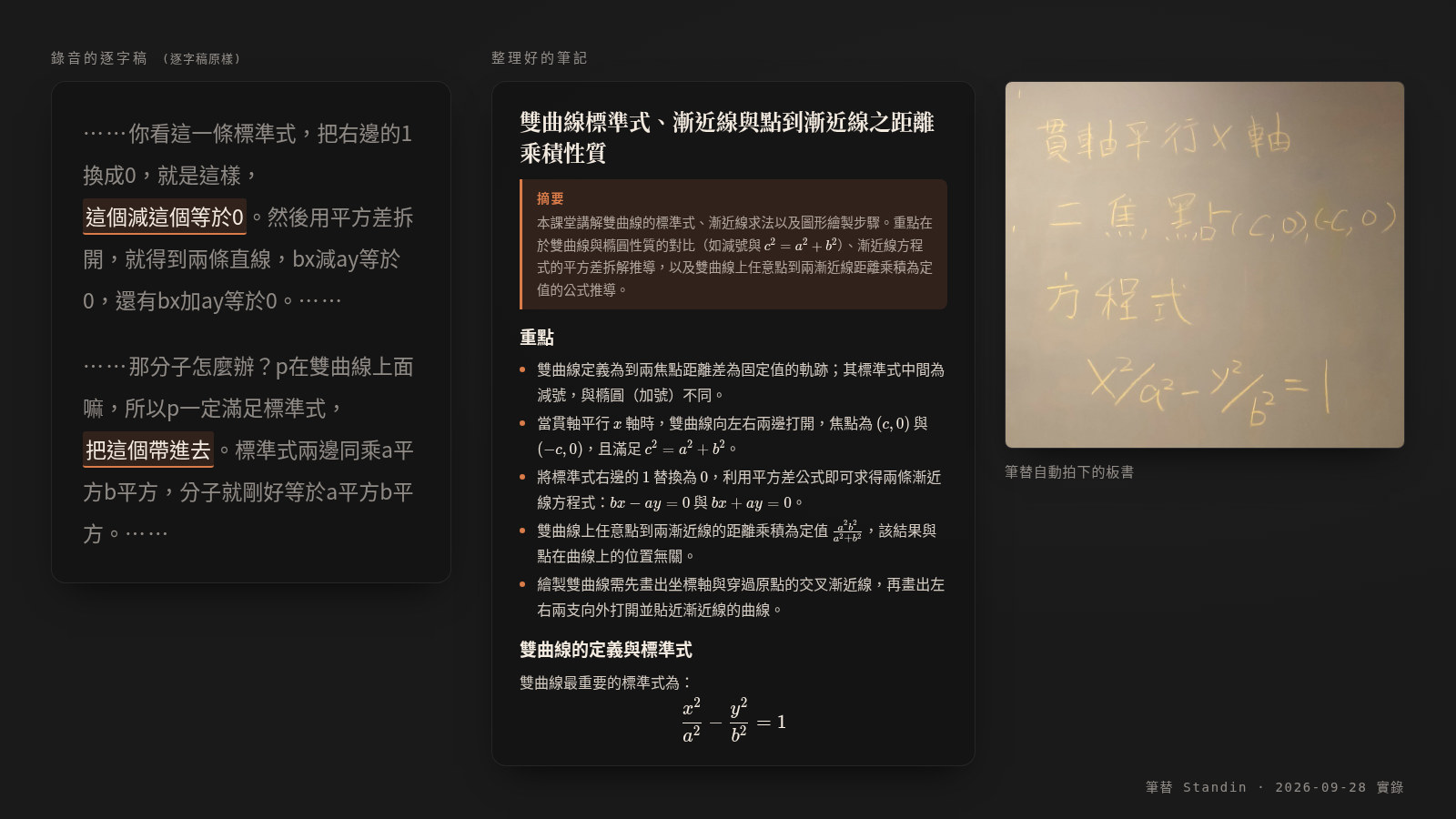
When the teacher says "this one" or "substitute it in," the thing being pointed at is on the board, not in the audio. A tool that only listens gives you back just the half you heard. Nothing passes through our servers — your data stays between you and Google.
Free to download; your first few notes are free. See your own notes before you decide to pay.
Wherever you're learning, it's there
Students
"Write it down and you fall behind; listen closely and your notes stay empty." Hand that trade-off over: the moment class ends, today's slides, board work, and key points are already sitting in your review folder.
At work
Training sessions, industry talks, certification courses. Everyone else walks away with a recording they'll never replay. You walk away with organized notes and the matching slides — in your own note library, searchable any time.
Self-study
Online courses, public lectures — just prop your phone up facing the screen. It photographs each slide change and transcribes the audio automatically — tap organize when you're done, and the notes appear in your folder.
Three facts, not three adjectives
An audio-only tool has no picture to look at, so a class comes back as a transcript that is grammatically complete and whose references point at nothing. That is not a question of transcription accuracy — it never saw the board. Standin photographs the board while it records, so the formula, the working and that slide travel into the same note as the key points.
A cloud service's recording has to be uploaded to its servers first. What happens to it after that is decided by that company's policy of the day — and a policy can be changed at any time, without anyone telling you. Standin has no servers: the recording only ever travels between your phone and your own Google account, so the question does not arise here.
Stop the subscription, and the notes locked inside the service go with it. Standin's output is a plain Markdown file, sitting in your own folder — it's still there even if the app itself disappears.
One button, three steps
Press record
Prop the phone up on the desk. When the slide changes and settles, it photographs it automatically — only the sharpest shot of each slide is kept.
Tap organize when it's over
Transcription and organizing run on your own Google key. Measured at about US$0.121 for a 50-minute class, paid straight to Google — no markup in between.
The note lands in your folder
Title, key points, the full text by section, and the matching slide photos — plain Markdown, opens straight in Obsidian, fully searchable.
How Standin differs from Otter, NotebookLM, Tongyi Tingwu
| Standin | Otter Pro | NotebookLM | Tongyi Tingwu | |
|---|---|---|---|---|
| Records the class for you | One button measured single take: 1:51:09 |
Yes 90-minute cap per recording |
No recording feature You record it yourself and import manually |
Yes (meeting-oriented) |
| Auto-photographs slides | Yes, on each slide change | No | No (you photograph and import yourself) | No |
| Monthly quota | No quota on the plans Doesn't sell minutes — billed through your own Google account |
1,200 minutes/month | Free tier caps notebook count and source count | Free for 90 days, then usage-based |
| Whose servers the recording passes through | Only between you and Google No cloud queue Your phone talks to Google directly — no one else's line ahead of you |
Otter's servers | Google, stored in its own service | Alibaba Cloud |
| Who owns the notes | Plain Markdown, in your own folder Directly editable Still there if you delete the app |
Locked inside the service | Output stays inside its app | Inside its own service |
| AI processing cost | Your own Google key Measured at about US$0.121/class (50 min) Could be 0 within the free tier |
Bundled in the subscription (US$100/year) |
Starts free; higher tiers tied to a Google AI subscription | Usage-based billing |
Competitor figures verified 2026-08-20/21 against each vendor's official pages; NotebookLM's "no recording feature" is from a third-party test in 2025-12.
AI processing cost is a 2026-08 measurement converted for a 50-minute class; the actual amount is whatever your Google account shows that day.
"Recordings are stored only on this device and cannot be recovered after the app is deleted" — verbatim, from inside a comparable app (measured 2026-08). Not uploading and files that are actually yours are two different things.
Four fair questions
"I have to get my own Google key? Sounds like a hassle."
Five minutes, once. In exchange for three things: transcription costs go straight to Google, with no markup; we never touch any of your content; and if this app ever disappears, your key and your notes are still yours. The app walks you through it step by step.
"Paying for AI usage myself — how much does that actually cost?"
Your key, your bill — we don't charge per minute. Measured at about US$0.121 (roughly NT$3.9) for a 50-minute class, and Google currently still offers a free quota, so it could be 0 within that. The app has a built-in monthly spending cap — it stops you before you go over, so there's no billing surprise.
"Will the AI organizing delete the one line I need for the exam?"
Our position: save time through layering, not by deleting your content for you. Every note reads top to bottom as summary, key points, then the full text by section — read the two-minute summary when you're pressed for time, and drop down to the full text when you're unsure. If you doubt any single line, the teacher's original words are saved into your own folder by default (as a transcript attachment, which you can turn off any time in settings), and it's fully searchable — if you can find it, you don't have to replay two hours of recording.
"No cloud sync — so how do I see it on my computer?"
You already have cloud sync — it's just not something we're selling you. The notes are plain Markdown files sitting in whatever folder you chose — what tool syncs that folder to your computer is up to you, and you're probably already using one. No need to add another subscription just to sync, because it was already your file.
Free for the whole closed test
It will cost money later, and the plans are not settled yet. What is settled: the AI is billed to your own Google account, and we take no cut of it. Whatever closed testers get, we will say so once the plans are decided.
Straight answers
Can I download it now?
It's in closed testing, Android first, with iOS on the roadmap. To be among the first testers, fill out the sign-up form below, we pick testers by situation and reach out directly.
Where are the recordings stored?
Recordings and photos stay on your phone; the finished notes are written into the folder you chose. We don't run a server, so there's no such thing as "your data is with us."
Is Google's free tier safe to use?
Honestly: content on the free tier may be used by Google to improve its models. That's usually fine for recording your own classes. The app's setup walkthrough says this again too.
How is this different from the free NotebookLM?
They divide the work differently. NotebookLM organizes files you already have, and does it well; but the hundred-plus minutes of the class itself — recording it, timing photos to the slides, importing everything — is still on you. That's exactly the part Standin handles: one button, and you have a ready Markdown note when class ends. If you want, feed the note Standin produces back into NotebookLM for deeper Q&A — the two work fine together.
What happens when I run out of AI quota?
The quota resets daily, so it's back the next day — based on measurements of the 2026-08 free-tier quota, normal use rarely hits the ceiling.
Do I have to use Obsidian?
No. The output is just Markdown files and photos in a folder — any editor can open them. Obsidian just happens to be the one that gets the most out of it.
Does organizing notes need an internet connection?
Recording doesn't. Tapping "organize" does, because transcription and organizing run on Google Gemini — using your own key.
Fill this out and we'll reach out
This round, we're looking for people who genuinely have classes to take notes on this semester — it's not first-come-first-served. Filling it out doesn't guarantee an invite, but we'll get back to you as quickly as we can.